
Reference
Reference
Use this helpful information to identify the right product for your application. If you have any questions or need assistance, do not hesitate to reach out.
What motion?
Push-pull, pull-only tension, brake, PTO, valve control, throttle, or not sure.
What do you have?
Part number, old cable, drawing, equipment model, or only a field measurement.
What dimensions?
Overall length, travel or stroke, mounting style, end fitting details, and temperature needs.
What quantity?
One-off replacement, small batch, expedited need, or OEM quantity.
Downloads
Catalogs and Brochures
Browse the complete Custom Control Cables catalog and product-specific catalogs and brochures for shifters, modulators, fluid level indicators, park brake systems, and engine, valve, and pump controls.
View Catalogs and BrochuresFeatures & Construction
HP cable construction notes
Core constructions
High Performance 1 x 7 coated core is available in 3, 4, and 6 Series cables. HP Core uses a proprietary coating over 1 x 7 wire rope for improved flexibility and higher push loads than armor core construction. Solid stainless steel cores are available in 3 Series push-pull, universal, positive lock, and PTO cables. Tension cables use a 1 x 19 HP coated core, while 8 Series push-pull cables remain armor core.
Liners
Felsted brand cables use polymer liners, available in standard HP cable construction at -65 to +225 degrees F and HEFT 2 high-temperature construction at -65 to +300 degrees F. Factory lubrication provides core performance without routine future service.
Stranded conduit
Multiple oil-tempered spring wires are placed in a long-lay pattern to protect the liner and inner core, maintain flexibility, and withstand compression and tensile loads. The long-lay construction helps reduce cable friction during operation.
Conduit jacket
Heavy-duty, thick-walled polymer jackets are extruded over the stranded liner for maximum cable strength. HP Cable uses a dark maroon jacket; HEFT 2 uses a satin black high-temperature jacket.
End fittings
Corrosion-resistant materials are used throughout. Standard 3, 4, and 6 Series rods and sleeves are 300 series stainless steel, with brass or aluminum hubs. 8 Series rods are stainless steel, and sleeves/hubs are aluminum with stainless steel options available.
Seals, boots, rods, and sleeves
High Performance seals help prevent moisture and contaminants from entering the cable. Polymer rod and sleeve bearing construction improves efficiency, sealing, and service life by reducing metal-to-metal contact.

Overall length
Measure the full cable assembly path, including mounting constraints and routing bends.
Travel or stroke
Record the usable movement required at the controlled end.
End fittings
Photograph or describe both ends, threads, clevises, eyes, ball joints, and brackets.
Environment
Note heat, routing near exhaust, corrosion exposure, and abrasion points.
Routing & Installation
Measure the routed path and protect cable life.

Routing and measuring
Measure the cable along the path it will take from the points where the cable hubs will be anchored. Follow the actual cable path as closely as possible and allow for the largest practical bend radii.
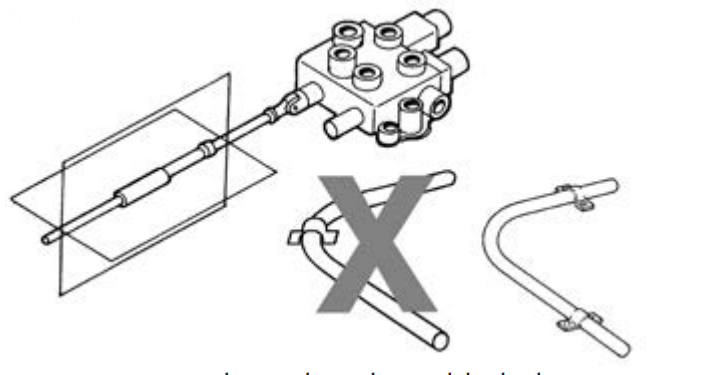
Installation Notes: Control & Work End
Where a cable is to be connected to objects requiring linear movement only, such as spool valves, maximum life and efficiency are achieved by accurately aligning, in both planes, the cable hubs and the controlled object.
It is important to securely anchor the cable hubs. Looseness of the mounting bracket will be perceived as lost motion or sponginess and will inhibit detent feel.
Clamping in the bend area may reduce bend radii under operating loads. Clamping at tangents to the bend is preferred.

Lever actuation
For highest efficiency and long life in lever applications, install the cable so the highest loads are operated in tension rather than compression.

Lever travel arc
Mount the cable so it lies on a plane midway through the arc traveled by the lever connection point.

Rod and sleeve swivel
Felsted push-pull cables with rod and sleeve type end fittings have a built-in swivel to handle deflections up to 8 degrees.
| Series | Operating Life Minimum |
|---|---|
| 3 | 3 inches* |
| 4 | 5 inches |
| 6 | 7 inches |
| 8 | 10 inches |
* HP Core: Solid Core has 6" Bend Radii